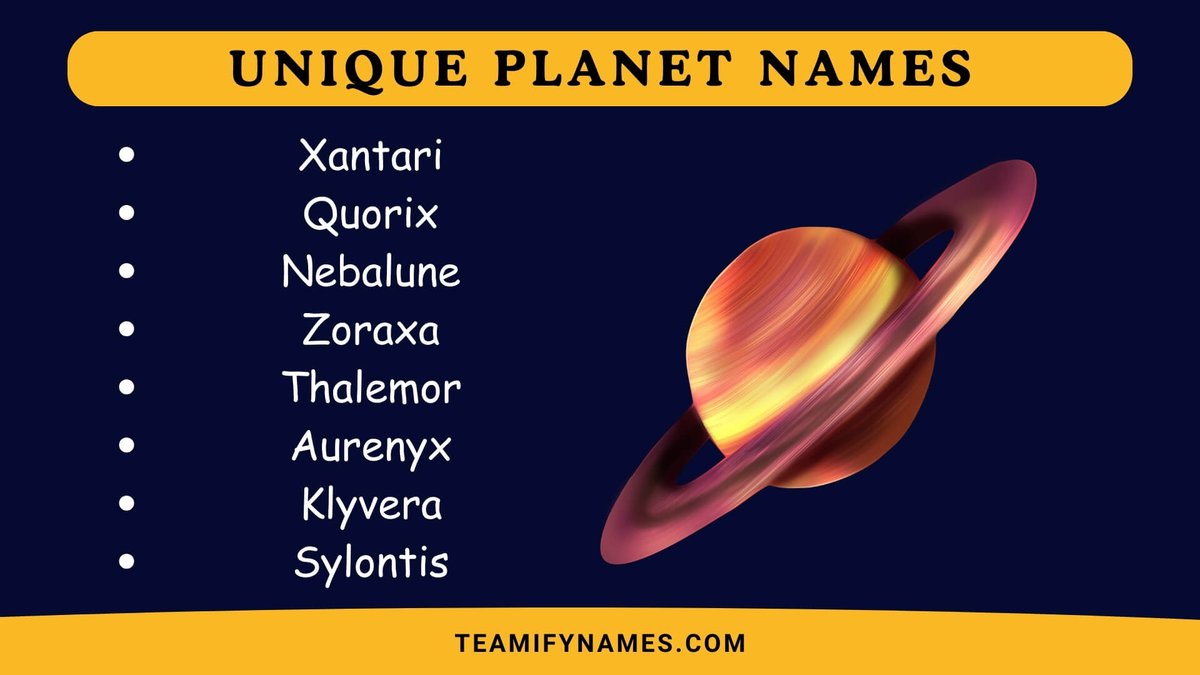
When you look up at the vast, star-strewn canvas of the cosmos, doesn't your imagination instantly begin to populate those distant points of light with worlds? Whether you're a science fiction author, a game designer, a dedicated world-builder, or simply a cosmic enthusiast dreaming of future discoveries, the act of naming a planet is a profound creative endeavor. It’s more than just a label; a truly compelling planet name enhances the entire universe, sets an immediate mood, hints at its environment, and evokes a sense of wonder that resonates deeply. The quest for truly unique and memorable planet names often begins by looking directly at the celestial body's own "personality"—its cosmic traits. These are the rich inspiration sources for unique planet names that transform a mere designation into a storytelling device.
A well-chosen name can whisper tales of ancient civilizations, roar with the fury of perpetual storms, or hum with the quiet promise of life, all before a single detail about the planet is even revealed. It’s the first impression, the cosmic handshake that invites exploration.
At a Glance: Your Toolkit for Naming Worlds
- Look to the Stars (and Planets): Base names on real astronomical traits like size, composition, atmosphere, and orbital behavior.
- Mythology & Language: Draw from ancient myths, root words, and linguistic elements for depth.
- Evoke Emotion: Consider the mood or story you want the name to convey—wonder, mystery, fear, hope.
- Keep it Memorable: Aim for names that are pronounceable, distinct, and easy to recall.
- Avoid Clichés: While common tropes can be a starting point, strive for a unique twist.
- Test It Out: Say the name aloud, write it down, and see how it fits within your universe.
Beyond the Label: Why Planet Names Truly Matter
Imagine a gas giant named "Xylos" versus one named "Stormreaver." One sounds vaguely alien, the other immediately conjures images of immense, swirling tempests. This illustrates the power of a name. A planet's designation isn't just a placeholder; it's an integral part of its identity, often the very first piece of information an audience receives. It can:
- Set the Mood: A name like "Acheron" suggests gloom and danger, while "Elysia" promises paradise.
- Hint at Environment: "Volcanis" tells you everything you need to know about its surface without further description.
- Evoke Wonder: Names like "Veridian Prime" or "Whisperwind" spark curiosity and a desire to explore.
- Enhance World-Building: Consistent naming conventions can build a cohesive, believable universe.
To unlock this power, we turn to the very fabric of planetary existence for our deepest wellsprings of inspiration.
The Foundation: Physical & Elemental Traits
The most direct and often most fruitful approach to naming a planet is to derive its name from its observable or hypothesized physical characteristics. These are the bedrock upon which planetary identities are built.
Size and Scale: From Motes to Megastructures
A planet's size is often its most distinguishing feature. Whether it's a diminutive rock or a colossal gas giant, this characteristic offers a clear path to unique names.
- Ideas for Tiny Worlds: Consider names that evoke smallness, delicacy, or even defiance against the vastness of space. Think of diminutive suffixes, names of small creatures, or words for subtle qualities.
- Examples: Minima, Pebble, Whisper, Glimmer, Tinia (from Tinyton).
- Ideas for Massive Worlds: For behemoths, lean into words that suggest grandeur, weight, power, or immense scale. Look for prefixes or roots meaning large, giant, or colossal.
- Examples: Gigas, Colossus, Titanis, Vastus, Megalith (from Megalith), Gigantor.
Composition: The Building Blocks of Worlds
What a planet is made of—rock, metal, gas, ice, water—is fundamental to its nature and can powerfully inform its name.
- Rocky Worlds: Emphasize solidity, minerals, ruggedness.
- Examples: Lithos, Terrania, Crag, Ironhold, Rockaria (from Rockaria), Igneos.
- Gas Giants: Focus on their gaseous nature, fluidity, storms, or lack of solid surface.
- Examples: Aerios, Cloudborn, Zephyr, Gassora (from Gassora), Nimbus.
- Water Worlds: Highlight oceans, rivers, ice, or the life they might support.
- Examples: Aquatica, Hydro, Mariner, Deluge, Aquamara (from Aquamara), Thallassa.
- Ice Planets: Suggest cold, crystalline structures, frozen landscapes.
- Examples: Glacia, Cryos, Frostmark, Rime, Borealis.
Surface Features: The Scars and Splendors
The visible landscape of a planet—its mountains, valleys, craters, volcanoes—provides a wealth of vivid imagery for names.
- Cratered Worlds: Names reflecting impacts, scars, ancient history.
- Examples: Pockmark, Scaros, Impactus, Crateria (from Crateria), Ruina.
- Mountainous Realms: Evoke towering peaks, treacherous ranges, verticality.
- Examples: Everestia, Pinnacle, Skyspire, Montania, Mountainia (from Mountainia), Oro.
- Volcanic Landscapes: Suggest fire, molten rock, creation, and destruction.
- Examples: Ignis, Pyros, Ashfall, Cinderia, Lavaria (from Lavaria), Vulcanis.
- Desert Planets: Names implying aridity, sand, heat, endless dunes.
- Examples: Dune, Aridia, Cimmeria, Solara, Scorchos.
- Jungle/Forest Worlds: Suggest lushness, greenery, tangles, vital energy.
- Examples: Viridia, Sylva, Bloom, Canopy, Gaiana.
The Veil: Atmospheric & Environmental Signatures
Beyond its core structure, a planet's atmosphere and overall environment create its unique character, influencing everything from its weather to its potential for life.
Atmospheres: The Planet's Breath
The composition and density of a planet's atmosphere dictate its skies, weather, and habitability. This offers rich metaphorical and literal naming opportunities.
- Breathable Atmospheres: Names suggesting life, clarity, or gentle winds.
- Examples: Aerion (from Aerion), Zephyra, Breathe, Skylar.
- Stormy Atmospheres: Names evoking chaos, thunder, perpetual tempest.
- Examples: Tempestus (from Tempestus), Gale, Rager, Fury.
- Vibrant Atmospheres (Auroras): Names hinting at color, light, electromagnetic phenomena.
- Examples: Aurorania (from Aurorania), Prismaris, Lumina, Shimmer.
- Thin/Tenuous Atmospheres: Names suggesting emptiness, silence, vulnerability.
- Examples: Echo, Vacuos, Whispersky, Aeria.
Temperatures: The Planet's Disposition
Is it a blazing inferno or a frozen wasteland? A planet's temperature is a powerful descriptor.
- Scorching Worlds: Names indicating heat, fire, burning, intensity.
- Examples: Inferna (from Inferna), Blazoria (from Blazoria), Cinder, Solara, Pyra.
- Frigid Worlds: Names suggesting cold, ice, stillness, darkness.
- Examples: Frostbitea (from Frostbitea), Chiller, Gelida, Cryon.
- Temperate Worlds: Names implying balance, comfort, life-sustaining conditions.
- Examples: Equilara, Moderata, Hearth, Edenica.
Potential for Life: The Ultimate Frontier
Perhaps the most captivating characteristic, the potential for life, opens up a realm of hopeful and vibrant names.
- Life-Sustaining Worlds: Names conveying vitality, growth, abundance, or thriving ecosystems.
- Examples: Vitalis (from Vitalis), Biohaven (from Biohaven), Edenica (from Edenica), Gaia, Genesis, Verdant.
- Barren/Lifeless Worlds: Names suggesting desolation, absence, or primordial emptiness.
- Examples: Necros, Barren, Void, Stasis, Deadfall.
- Emergent Life Worlds: Names hinting at new beginnings, nascent forms, potential.
- Examples: Progenitor, Bloom, Chrysalis, Sperion.
The Dance: Orbital Dynamics & Cosmic Jewelry
Planets aren't just static objects; they're dynamic participants in a cosmic ballet. Their interactions with stars, moons, and other celestial phenomena offer abstract yet potent naming ideas.
Multiple Moons: The Celestial Entourage
A planet with one or more orbiting moons has a richer, more complex dynamic, influencing tides, light, and culture.
- Names reflecting moons: Emphasize companionship, gravitational pull, or a celestial dance.
- Examples: Lunaris (from Lunaris), Selene, Orba, Circlet, Trina (for three moons), Stellarion (from Stellarion), Orbita (from Orbita).
- Specific Moon Names: If the moons themselves have compelling names, these could inspire the planet's name (e.g., a planet named after its most prominent moon, or a combination).
Rings: The Majestic Adornments
Planetary rings are among the most visually stunning cosmic features, offering a unique source of inspiration.
- Names reflecting rings: Focus on circles, halos, adornment, or the materials making up the rings.
- Examples: Ringaria (from Ringaria), Circlon (from Circlon), Haloora (from Haloora), Coronis, Banded, Aurea, Girdle.
Magnetic Fields: The Invisible Shield
A planet's magnetic field, though invisible, is a crucial protective layer, often giving rise to auroras.
- Names reflecting magnetism: Suggest power, protection, unseen forces, or polarity.
- Examples: Magneterra (from Magneterra), Polaria (from Polaria), Magnoverse (from Magnoverse), Shieldon, Flux.
Orbital Characteristics & Planetary Movements
The way a planet moves around its star, its axial tilt, or even a retrograde rotation can be deeply evocative.
- Orbital Period/Distance: Names suggesting speed, distance, or the journey itself.
- Examples: Chronos, Farreach, Swift, Wanderer, Ellipsia.
- Axial Tilts (Seasons): Names implying seasons, change, or orientation.
- Examples: Seasonis, Tiltoria, Axis.
- Retrograde Rotation: Names suggesting opposition, uniqueness, going against the flow.
- Examples: Oppositus, Backward, Reversa, Contra.
Interplanetary Missions & Discovery
Humanity's drive to explore and learn about these worlds is a story in itself. Names could reflect this legacy.
- Names honoring missions/discoverers: While often used for spacecraft or features on planets, sometimes the spirit of discovery can inspire the planet's name itself.
- Examples: Voyageris, Probe, Explorer, Galilea.
Beyond the Physical: Evoking Narrative & Mood
While cosmic traits provide a solid foundation, sometimes the most unique names come from stepping back and considering the broader narrative, emotional resonance, or even a touch of whimsy.
Mythological Roots & Ancient Lore
Many of our own solar system's planets are named after Roman and Greek gods. This tradition offers a deep well of powerful, resonant names.
- Gods and Goddesses: Look for deities associated with specific elements (sea, sky, war, love), domains (underworld, harvest), or traits (wisdom, speed).
- Examples: (Beyond the obvious) Hecate (goddess of magic), Morpheus (god of dreams), Tartarus (underworld).
- Mythical Creatures: Dragons, titans, nymphs, or legendary beasts can inspire names that evoke grandeur or danger.
- Examples: Leviathan, Gryphon, Harpyia.
- Ancient Place Names: Lost cities, legendary lands, or historical regions can lend an air of mystery and antiquity.
- Examples: Atlantis, Avalon, Xanadu.
Linguistic Flair & Creative Wordplay
Sometimes, simply playing with sounds, prefixes, suffixes, and foreign words can create truly unique and memorable names.
- Portmanteaus: Combine two words or word fragments to create a new one.
- Examples: "Sky-stone" -> Skystone, "Aqua-fire" -> Aquafyre.
- Root Words: Explore Latin, Greek, or other language roots that relate to your planet's characteristics.
- Example: Sol (sun) + terra (earth) -> Solterra (a sun-blasted world).
- Sound Symbolism (Phonaesthetics): Choose sounds that evoke the planet's nature. Hard consonants for rocky worlds, soft vowels for gas giants.
- Examples: "Kryptos" (hard, mysterious), "Elara" (soft, graceful).
- Reversed or Scrambled Words: A simple trick to create an alien-sounding name from an earthly concept.
- Example: "Earth" reversed -> Htrae (or something more artful).
Evoking Emotions & Concepts
What feeling do you want the planet's name to invoke? Fear, wonder, serenity, loneliness?
- Names of concepts/emotions:
- Examples: Serenity, Despair, Hopewell, Vengeance, Solace.
The "Funny" Element: A Touch of Whimsy
Not every planet needs to be a grand, serious affair. Sometimes, a touch of humor or quirkiness can make a planet memorable, especially in lighter fiction or gaming contexts.
- Nonsensical/Playful Names:
- Examples: Zoombia (from Zoombia, implying fast-paced), Giggleon (from Giggleon, laughter/joy), Bananaland (from Bananaland, sentient bananas), Wobble, Flumph.
- This approach is about subverting expectations and can create a truly unique identity if used judiciously.
Crafting Your Name: Practical Tips for Astounding Results
With so many inspiration sources, how do you synthesize them into a perfect name?
- Start with Core Traits: Identify the 1-3 most defining characteristics of your planet. Is it a "cold, ringed gas giant" or a "hot, volcanic, desert moon"?
- Brainstorm Keywords: List words, synonyms, mythological figures, and root words related to those core traits. Don't censor yourself; just get ideas down.
- Mix and Match: Combine elements from your keyword list. Try prefixes, suffixes, and different linguistic styles.
- Consider the Vibe: Does the name sound like the planet? Say it aloud. Does "Crateria" sound like a cratered world?
- Check for Uniqueness: A quick search can confirm if your name is already heavily used. While a degree of familiarity can be good, you want to avoid direct copies.
- Simplicity vs. Complexity: Some universes benefit from short, punchy names, others from more elaborate, melodic ones. Find the balance for your story.
- Universe Cohesion: If you're naming multiple planets, consider if there's a theme or convention. Are all planets in this system named after Greek heroes? Or are they all single-syllable?
- Get Feedback: Others might catch something you missed or offer a fresh perspective.
For those moments when you need a creative spark or a vast array of possibilities, sometimes a helping hand is invaluable. Use our planet names generator to explore a universe of options that blend scientific inspiration with imaginative concepts, perfect for any creative or educational project.
Common Pitfalls to Avoid When Naming Your World
Even with the best intentions, naming can sometimes go awry. Watch out for these common missteps:
- The "Obvious" Trap: Naming a water world "Wateria" might be accurate, but it lacks flair. Strive for names that evoke without being entirely literal.
- Unpronounceable Names: While "alien" is good, names that are impossible to say or remember detract from immersion. Keep it reasonable.
- Inconsistent Naming Schemes: If your first planet is "Aerion" and your second is "Steve's World," you might break the reader's immersion. Maintain a consistent aesthetic.
- Accidental Comedy: Unless it's intentional, avoid names that sound unintentionally silly or have unfortunate double meanings in other languages.
- Overly Generic Names: "Planet X" or "New Earth" might work in very specific contexts, but they rarely inspire wonder.
Ready to Name Your World? Your Cosmic Canvas Awaits!
Crafting unique planet names is a journey as vast and rewarding as space itself. It’s about more than just stringing letters together; it's about imbuing a celestial body with identity, history, and a future. By drawing upon the incredible diversity of cosmic traits—from the fiery heart of a molten world to the icy rings of a distant giant—you can create names that not only describe but also resonate.
Think of your planet's name as a miniature poem, a haiku of its existence. Let its size, composition, atmosphere, or orbital ballet whisper possibilities into your ear. Let mythology lend it gravitas, or wordplay give it a unique twist. With these boundless sources of inspiration, you're not just naming a planet; you're bringing a new world to life, one evocative syllable at a time. So go forth, explore the infinite possibilities, and give your cosmic creations the unforgettable names they deserve.